We love what we do. We’re grateful for every call. (It’s literally in our name.) But if we’re being completely honest, a lot of the calls we get could have been prevented, or at least handled better, if homeowners knew a few basic things before picking up the phone.
This isn’t us trying to talk you out of calling a plumber. It’s the opposite. We want you to call the RIGHT plumber, at the RIGHT time, for the RIGHT reasons. And we want you to know enough about your own home that you’re never caught completely off guard.
So here’s what we wish every Jacksonville homeowner knew.
1. Know Where Your Water Shut-Off Is Before You Need It
This is the single most important thing in this entire post. If you take nothing else away, take this.
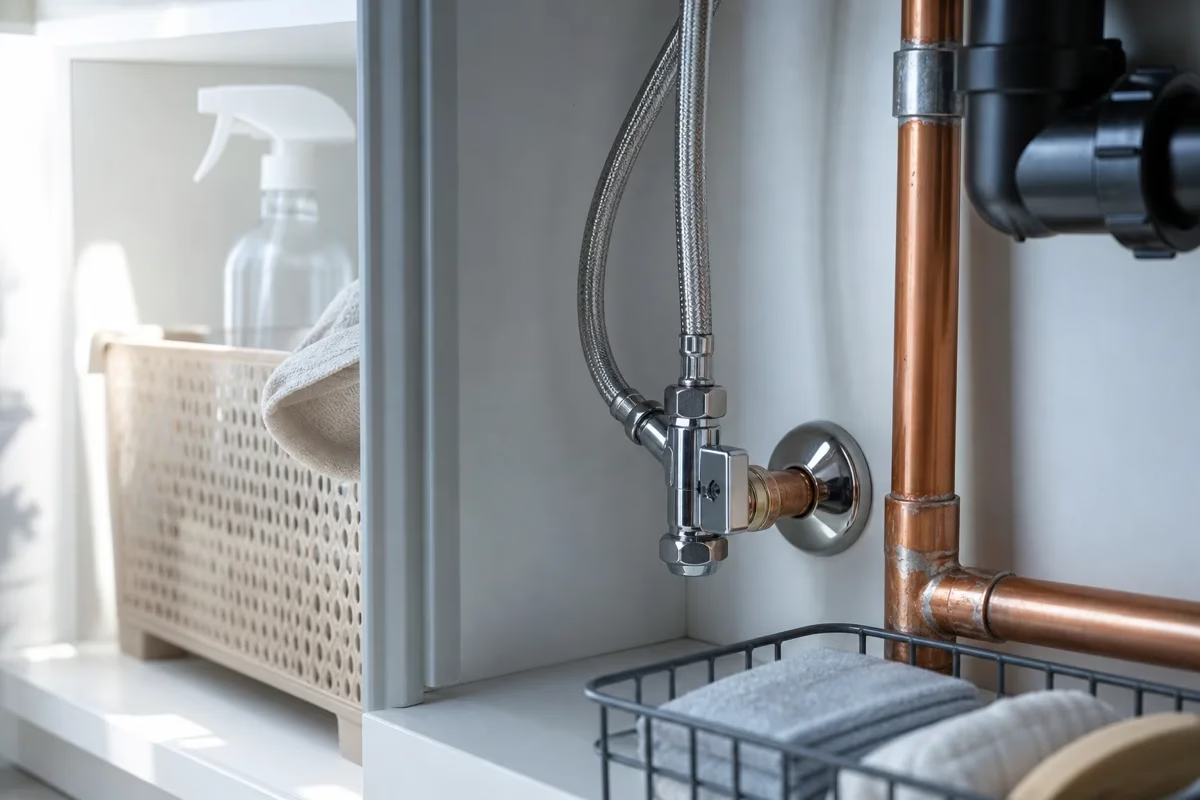
Somewhere in your home, there is a main water shut-off valve. It might be in your garage. It might be near your water heater. It might be in a utility closet you haven’t opened since you moved in. Go find it. Right now. Seriously.
When a pipe bursts or a water heater starts flooding your garage, the difference between $500 in damage and $15,000 in damage is how fast you can shut off the water. Every minute counts. If you’re scrambling around your house at 11 PM trying to figure out which valve stops the water while your floors are getting soaked, you’re already behind.
There’s also a shut-off at the street. It’s in a concrete box near the curb, usually marked “water.” You might need a special key to turn it (you can buy one at Home Depot for $10). If everything inside fails, that’s your last resort.
We’ve shown up to homes where the homeowner watched water pour out of a pipe for 20 minutes because they didn’t know where the shut-off was. Twenty minutes. That’s the difference between mopping up and ripping out drywall.
2. Not Everything Is an Emergency
We offer emergency service. We’re happy to come out at 2 AM if you need us. But here’s the honest truth: a lot of “emergencies” aren’t actually emergencies.
Actual emergencies:
- Active flooding or water pouring from somewhere it shouldn’t be
- Sewage backing up into your home
- Gas smell near a water heater or gas line
- No water at all to the entire house
Not emergencies (even though they feel like it):
- A slow drip from a faucet
- One toilet running
- Low water pressure
- Water heater making noise but still producing hot water
- A drain that’s slow but not completely stopped
If you can shut off the water to the fixture, contain it, and wait until morning, you’ll save yourself the after-hours rate and we can address it during normal business hours. We’d rather tell you that honestly than charge you emergency pricing for something that could have waited 8 hours.
If water isn’t actively going somewhere it shouldn’t be, and nobody’s in danger, it can probably wait until morning. We’d rather save you the money and do it right during the day.
3. Your Water Heater Has an Expiration Date
Nobody thinks about their water heater until it stops working. It’s sitting in a corner of your garage or a closet, doing its job quietly for years, and then one day it just… doesn’t.
The average water heater lasts 8 to 12 years. If yours is older than that, it’s not a question of IF it will fail, it’s a question of WHEN. And the signs are usually there months before it actually goes:
- Rusty or discolored hot water
- Less hot water than you used to get
- Strange popping or rumbling sounds
- Small puddles around the base
- Your JEA bill creeping up for no obvious reason
Replacing a water heater proactively costs less, takes less time, and doesn’t involve cold showers. Replacing one in an emergency costs more, is harder to schedule, and usually involves at least one very unpleasant morning.
Side note: we’re running a Pay Your Birth Year special on water heater replacements right now. Born in 1990? You pay $1,990 for a brand new 50-gallon unit, professionally installed, old one hauled away. It’s a pretty great deal if you know your water heater is on its last legs.
4. Get Multiple Quotes (Yes, Even From Us)
We believe in our pricing. We do flat-rate, upfront quotes with no surprises. But we also believe you should get at least two or three quotes for any job over a few hundred dollars.
Here’s what to look for when comparing:
Are they licensed and insured? Florida requires plumbers to be licensed. Ask for the license number. Check it on the state website. If they can’t provide one, walk away. If something goes wrong on an uninsured job, you’re the one paying for the damage.
Is the quote itemized? “Water heater replacement: $3,200” doesn’t tell you anything. What unit? What’s the labor? Are permits included? What about hauling away the old one? A good quote breaks it all down.
Do they charge a trip fee? We charge $99 for a service call, which includes a full diagnostic and gets credited toward the job if you move forward. Some companies offer “free estimates” but bake that cost into higher job pricing. There’s no free lunch in plumbing.
What do the reviews say? Not just the star rating. Read the actual reviews. Do they show up on time? Do they clean up? Do they communicate? Those details matter more than a half-star difference on Google.
An honest plumber wants you to get multiple quotes. If someone is pressuring you to sign right now, that’s a red flag.
5. Jacksonville’s Water Is Hard on Your Plumbing
If you’ve lived in Jacksonville for any amount of time, you know the water is hard. Like, really hard. That mineral buildup you see on your shower head and faucets? That’s happening inside your pipes, your water heater, your dishwasher, and your washing machine too.
Hard water causes:
- Buildup inside pipes that reduces water flow over time
- Sediment in your water heater that makes it less efficient (and shorter-lived)
- Scale on fixtures that’s annoying to clean and eventually damages the finish
- Stiff, scratchy laundry (yes, that’s a water quality issue, not a detergent issue)
A water softener or filtration system can help, and it’s one of those investments that pays for itself over time in reduced wear on your appliances and plumbing. Ask us about it if you’re curious. We’ll give you an honest assessment of whether your water quality justifies the investment.
6. The “Handyman Special” Usually Costs More in the Long Run
We see this all the time. Homeowner hires a handyman or a buddy to do plumbing work because it’s cheaper. And sometimes it is cheaper upfront. But plumbing is one of those trades where doing it wrong doesn’t just mean it doesn’t work. It means water goes places it shouldn’t, mold grows where you can’t see it, and the “fix” creates a bigger problem than the original issue.
We’ve been called to fix handyman plumbing jobs that turned a $300 repair into a $2,500 repair because the connections leaked behind the wall for months before anyone noticed. We’ve seen water heaters “installed” without proper venting. We’ve seen drain lines connected backwards.
If you’re fixing a leaky faucet or replacing a toilet flapper, sure, YouTube it. But anything involving supply lines, drain connections, gas lines, or anything behind a wall? Call a licensed plumber. Please.
The cheapest plumbing job is the one you only have to do once.
The Bottom Line
Your home’s plumbing is one of those things you don’t think about until something goes wrong. And that’s fine. You shouldn’t have to think about it every day. But knowing the basics, like where your shut-off is, what’s actually an emergency, and when to call a pro vs. when to wait, saves you money, stress, and water damage.
And when you do need to call a plumber, we’re here. Licensed, insured, upfront pricing, and genuinely grateful for the work.
Call us at (904) 643-3946 or visit tgplumber.com to schedule service.
Need a Jacksonville plumber? Learn more about our Residential Plumbing service, or request a quote today.