When a restaurant drain backs up, the first question is usually simple.
Who do we call?
Sometimes the answer is the certified grease hauler. Sometimes it is the plumber. Sometimes the kitchen needs both, because grease trap service and plumbing repair solve related but different problems.
That difference matters during a busy shift.
If the grease trap is overdue, a certified hauler may need to clean it and handle the required records. If the trap was recently serviced and the floor drain still backs up, the drain line may need plumbing diagnosis. If a line has years of grease and food buildup, the kitchen may need professional drain cleaning or hydro-jetting when the pipe condition allows it. If the pipe is damaged, cleaning alone may not solve the problem.
Guessing wastes time.
This guide explains the practical difference between grease trap pumping and plumbing repair so Jacksonville restaurant operators know what problem they are trying to solve before the next backup.
The Greatful Plumber works on the plumbing side of the issue. TGP cleans, hydro-jets when appropriate, assesses commercial drain and plumbing problems, and repairs plumbing-side issues. TGP does not position itself as a certified grease hauler and does not submit JEA pump-out reports. When the issue points to certified hauling, trap records, or FOG program compliance, TGP can help you understand the plumbing side and coordinate the next step with the right specialist.
What JEA regulates locally
JEA says food service establishments and commercial or institutional kitchens connected to the JEA wastewater system must participate in the Commercial Fats, Oils, and Grease program.
JEA also says those facilities must use a properly functioning grease trap or interceptor.
That does not make every slow kitchen drain a grease trap problem.
It does mean restaurant operators need to keep grease service, documentation, and plumbing diagnosis in separate lanes.
JEA’s Commercial FOG Program outlines these requirements for food-service facilities:
- Interceptors 750 gallons and up must be cleaned at least every 90 days, or more often if grease and solids reach 25 percent of tank volume.
- Intermediate traps from 51 to 749 gallons must be cleaned on a schedule not to exceed 30 days.
- Traps under 50 gallons must be cleaned on a schedule not to exceed 15 days.
- Pump-out reports must be submitted no more than five business days after cleaning.
- Certified haulers submit required reports and maintenance records for the facility.
- Pump-outs by non-certified haulers cannot be submitted to JEA and are considered invalid.
- JEA no longer permits customers to self-clean grease interceptors.
Restaurant operators should verify current requirements directly with JEA and their certified hauler before making compliance decisions.
From a plumbing standpoint, the important point is simple: certified hauling handles the grease trap clean-out and reporting lane. Plumbing service handles the pipes, fixtures, drains, backups, buildup, and repairs on the plumbing side.
What grease trap pumping handles
Grease trap pumping removes accumulated fats, oils, grease, solids, and wastewater from the trap or interceptor.
Depending on the system and provider, the certified hauler may:
- clean the trap or interceptor
- remove grease and solids
- dispose of waste properly
- provide service documentation
- submit required reports
- help the restaurant stay on an appropriate cleaning schedule
That work matters.
If the trap is overloaded, inaccessible, neglected, or on the wrong schedule for the kitchen’s volume, the restaurant can see odors, slow drainage, backups, and maintenance headaches.
But pumping the trap does not automatically clean every drain line in the kitchen.
A trap can be cleaned while the downstream line still has buildup. A hauler can remove what is inside the trap without repairing a broken pipe, clearing a fixture line, checking slope, or diagnosing why one floor drain keeps backing up.
That is where the plumber comes in.
What plumbing repair and drain cleaning handle
Restaurant plumbing includes the drains, branch lines, cleanouts, floor drains, pipes, and related connections that keep the kitchen and building working.
When a restaurant calls a plumber for a backup, the problem may involve:
- a local clog near a sink or floor drain
- grease buildup in a kitchen line
- food debris or solids in a branch line
- a blocked or hard-to-access cleanout
- damaged pipe
- poor slope or standing water
- root intrusion farther downstream
- fixture problems
- venting concerns
- a main line restriction
TGP’s role is to assess the plumbing side and explain what is happening in plain English.
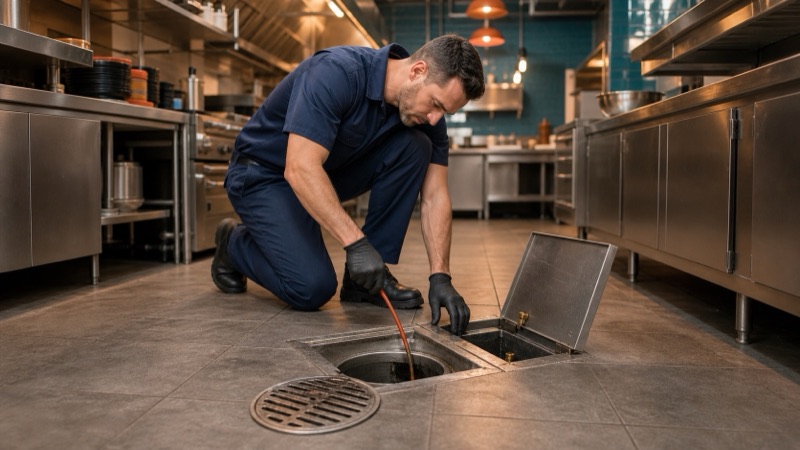
That may mean commercial drain cleaning. It may mean hydro-jetting when buildup is the issue and the pipe condition allows it. It may mean plumbing-side repair. It may also mean coordinating with a certified hauler if the plumbing symptoms point back to trap service, records, sizing, or access.
The important point is this: plumbing repair is not the same as grease trap pumping.
If a kitchen treats them as interchangeable, the same problem can come back.
Signs the issue may be the grease trap service lane
Review the grease service lane when the symptoms point toward trap condition, trap access, or maintenance rhythm.
Possible signs include:
- records show service is overdue
- the trap area has strong odors
- the kitchen cannot find recent pump-out documentation
- visible grease or solids appear where they should not
- several kitchen drains slow around the same time
- backups happen after heavy production or busy service
- staff report that the trap area is blocked or hard to access
- menu, volume, or equipment changed without a service schedule review
These signs do not prove the trap is the only issue.
They mean the restaurant should check records, talk with the certified hauler, and make sure the maintenance schedule still fits the kitchen.
Signs the issue may be the plumbing lane
Call a plumber when the symptoms point toward the drain line, fixture, pipe, or a repeat plumbing problem.
Possible signs include:
- the same drain keeps clogging
- a floor drain backs up repeatedly
- water backs up after a recent trap clean-out
- odors return quickly after cleaning
- several fixtures act up in a way that suggests a line issue
- staff keep plunging the same drain
- the problem returns soon after a temporary clearing
- sinks gurgle when water drains
- there is water where it should not be
- the issue may involve a leak, fixture, shutoff, or pipe repair
This is where diagnosis matters.
A local clog near a prep sink is different from grease buildup in a line. A damaged pipe is different from an overdue trap. A line that needs hydro-jetting is different from a line that needs repair.
The first visit may restore flow. The bigger question is whether the problem is likely to return.
When both parties need to coordinate
Restaurant systems are connected.
That means one backup can involve more than one provider.
For example:
- The certified hauler cleans the trap, but the downstream line still has heavy buildup.
- TGP clears or hydro-jets a kitchen line, but the grease service schedule still needs review.
- A floor drain backs up because a branch line is restricted, while the trap also needs documentation checked.
- A hauler documents heavy accumulation, while the plumber sees line restrictions that need cleaning.
- A pipe problem causes repeat backups that trap pumping alone cannot solve.
The better question is not “who was here last?”
Ask:
- What was actually serviced?
- Was the trap cleaned, the line cleaned, or both?
- Were records provided?
- Which fixtures backed up?
- Did the same drain have trouble before?
- Did the problem happen during peak service?
- Did anyone inspect or assess the line?
- What should the manager watch for next?
The answers help the restaurant decide whether the next call belongs to the certified hauler, the plumber, or both.
What restaurant managers should track
Good notes make both vendors more useful.
Track:
- last grease trap or interceptor clean-out date
- certified hauler name
- pump-out reports or service tickets
- slow drain reports
- backup events
- odor complaints
- photos of problem areas
- which fixtures were affected
- whether the issue happened during peak service
- whether the problem returned after cleaning
- any menu, volume, or equipment changes
You do not need a complicated system.
You need enough information to see a pattern before the kitchen loses service time.
Do not normalize workarounds
The worst restaurant plumbing problems often get a trial period.
Staff know which drain is slow. Someone knows which sink smells bad after closing. A manager knows the mop sink acts up after busy weekends. A cook knows the floor drain gurgles when the dish area dumps water.
Everybody adapts because service has to continue.
That is risky.
Workarounds hide patterns. If the same line needs plunging every week, that is not routine. If staff avoid one sink because it drains slowly, that is not wisdom. If odors keep returning after cleaning, that is not just restaurant life.
Create a simple reporting rule: if a drain slows, smells, gurgles, backs up, or needs plunging more than once, management needs to know.
Then write it down.
How The Greatful Plumber helps
The Greatful Plumber helps Jacksonville restaurants and commercial kitchens with the plumbing side of grease-related drain problems.
TGP can help with:
- commercial drain cleaning
- hydro-jetting when appropriate
- kitchen drain assessment
- floor drain backup support
- plumbing-side repair when it fits the scope
- plumbing-side documentation
- coordination when certified hauling or compliance follow-up is needed
TGP does not replace the certified grease hauler, and TGP does not submit JEA pump-out reports.
If your Jacksonville restaurant has slow kitchen drains, repeat backups, odors, or confusion about whether the problem is the trap or the plumbing line, call The Greatful Plumber at (904) 643-3946 or use the contact page to schedule commercial plumbing help.
FAQ
Is a plumber the same as a grease trap hauler?
No. The certified hauler handles grease trap clean-out, disposal, and required reporting. A plumber handles the plumbing side: drains, backups, buildup, hydro-jetting when appropriate, assessment, and plumbing-side repair.
What if the trap was pumped but the drain still backs up?
The drain line may still have buildup, a local clog, damaged pipe, poor slope, or another issue that pumping the trap did not address. That is when plumbing-side assessment makes sense.
Can The Greatful Plumber pump my grease trap or submit JEA reports?
No. TGP is not positioning itself as a certified grease hauler or JEA pump-out reporter. TGP helps with commercial plumbing diagnosis, cleaning, hydro-jetting when appropriate, repair, and coordination when specialist work is needed.
How often does JEA require grease traps to be cleaned?
JEA’s Commercial FOG Program publishes cleaning intervals based on trap or interceptor size, including 90 days or sooner for 750-gallon-and-up interceptors, 30 days for 51-to-749-gallon traps, and 15 days for traps under 50 gallons. Restaurant operators should verify current requirements directly with JEA and their certified hauler.
Not Sure Whether It Is the Trap or the Plumbing Line?
Slow drains, repeat backups, and odors need the right next step. Get the plumbing side assessed before the next rush.