

We get a call almost every week that goes something like this: "My JEA bill is suddenly higher than it's ever been. Nothing's changed. Can you come look?"
About half the time, it's a slab leak.
Slab leaks are sneaky in a way that most plumbing problems aren't. A burst pipe under a sink soaks the cabinet and gets your attention in five minutes. A slab leak runs quietly under your foundation for weeks or months, slowly soaking the concrete, the soil, the framing. By the time you notice, the bill might be $5,000 in excess water. The damage might be $50,000.
If you own a Florida home built after 1970, there is a good chance it sits on a slab. If it does, you may have plumbing in or under that slab, which means a slab leak is possible. For the bigger picture on hidden leaks before they turn into higher bills, our Jacksonville leak detection guide is a good companion. Here's what every Jacksonville homeowner should know before one shows up, and when it is time to call for residential plumbing help.
Why Florida Has So Many Slab Homes (And Why That Matters)
When the rest of the country was building basements, Florida couldn't. The water table is too high. The soil shifts. Pouring a concrete slab and running the plumbing through it (or just under it) was faster, cheaper, and worked fine in a climate without freezing winters.
The result: the overwhelming majority of single-family homes in Florida built since the 1970s sit on a poured concrete slab. Your hot and cold water supply lines, and sometimes your drain lines, are either embedded in the concrete or buried in the dirt right underneath it.
When everything works, it's invisible. When something fails, the only way to get to it is through the concrete.
What Causes a Slab Leak
Five main culprits, in roughly the order we see them:
1. Copper pipe corrosion. Copper has been the dominant supply line material in Florida slab homes for decades. It's durable, but it's not eternal. Acidic soil, water chemistry, and chlorine from the municipal supply slowly eat through copper from the inside, the outside, or both. Pinhole leaks develop. Once one shows up, others usually follow within a few years.
2. Polybutylene failure. If your home was built between 1978 and 1995, there's a real chance you have polybutylene supply lines, flexible gray plastic, often called "Quest." It was sold as the pipe of the future. Turns out, it reacts with chlorine in municipal water and becomes brittle. Class-action settlements followed. Florida insurance companies don't love it. Citizens specifically flags polybutylene on four-point inspections for homes 20+ years old. If you have poly, it is worth getting it inspected before a small failure turns into a bigger water line repair problem.
3. Pipe abrasion. As the slab moves (and Florida slabs move, even imperceptibly), pipes embedded in or against the concrete rub. Over years, that abrasion wears through the pipe wall. Common at fitting joints and where pipes pass through stress points.
4. High water pressure. Builder-grade pressure regulators fail. When they do, your incoming pressure can climb to 100 PSI or higher. Fittings and joints that would have lasted 40 years at 60 PSI start failing in 15 at 90+. We see this constantly.
5. Soil shift. Florida's sandy and clay-heavy soils expand and contract with moisture. A long dry period followed by heavy rain, like our usual May-to-September pattern, moves earth. Pipes don't love being moved. Joints loosen. Fittings crack.
The Warning Signs (Most People Miss the First Three)
Slab leaks rarely announce themselves. They whisper for weeks before they shout. Here's what to listen for:
Your JEA bill is higher than it should be. Pull up the last 12 months on your JEA account. If usage has been steady for years and is suddenly up 30%, 50%, or doubled, and nothing in your household has changed, water is going somewhere it shouldn't. We'd say this is the single most reliable early warning sign, and most homeowners ignore it for two or three billing cycles before they call.
Warm or hot spots on your floor. A leak on the hot-water line warms the slab above it. If you notice a section of tile that's noticeably warmer than the rest, especially in the middle of a room (not over a heating duct), that's a hot-water slab leak until proven otherwise. We've identified leaks just by walking barefoot through a house.
The sound of running water when nothing's on. Stand still in your kitchen at midnight. Listen. If you hear a faint, constant rushing or trickling and you can't find the source, water is running somewhere. Often in the slab.
Mildew smell, especially in closets and along walls. A slow leak doesn't always show as a wet floor. The water can wick into wall cavities, soak insulation, and breed mold for months before any visible damage appears. That musty smell in the back closet matters.
Cracks in tile or hardwood that weren't there before. Slab movement caused by sub-slab water erosion shows up as new tile cracks, lifting hardwood, or doors that suddenly don't close right.
Visible moisture or efflorescence on the foundation. White chalky deposits on exterior foundation walls (called efflorescence) indicate water moving through the concrete. Worth a closer look.
A water meter that spins when nothing should be running. Shut off every fixture in the house. Walk to your meter. If the small dial is moving, you have a leak. Could be a slab leak. Could be a toilet flapper. Either way, you need to find it.
How We Actually Detect Slab Leaks
We don't tear up floors hoping to find them. We've got tools.
Acoustic listening. A specialized listening device that picks up the high-frequency hiss of pressurized water escaping a pipe. We pressurize the system, then walk the floor with the equipment until we localize the leak. This is what most professional detection looks like.
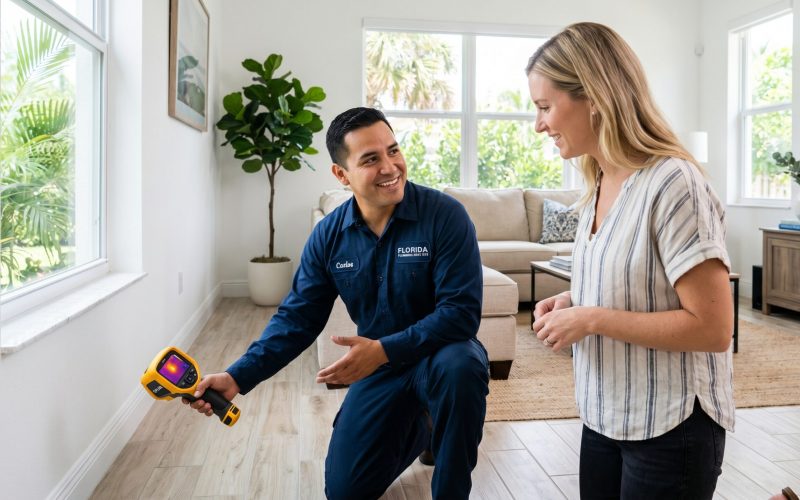
Thermal imaging. Particularly good for hot-water leaks. The thermal camera shows the temperature differential through the slab. Effective for leaks of any size if the line is hot.
Pressure isolation. We isolate sections of the supply system and watch for pressure drop. Helpful for confirming whether the leak is on the hot or cold side, and roughly where it is.
Tracer gas (occasional). For really stubborn cases, we charge the line with an inert tracer gas, and a sniffer detects where it escapes the slab.
A typical slab leak detection visit in Jacksonville runs around $280 to $400, and you walk out with a marked location and a recommendation. That's significantly cheaper than the alternative (jackhammering a slab on a hunch).
The Repair Options, Ranked By Cost
Once we've found the leak, you've got choices. Here's the lay of the land:
Spot repair (open the slab). We jackhammer through the concrete at the leak location, fix the pipe, patch the slab. Most direct. $500 to $2,000 depending on access and patching. Usually the right call when only one leak exists and the rest of the system is healthy.
Reroute (abandon the slab line). We bypass the failed section by running new pipe through the walls, ceiling, or attic. The bad pipe gets capped and abandoned in the slab. $600 to $4,000 for a single line. Good option when you don't want to disturb the slab but you don't need a full repipe.
Epoxy lining. A cured-in-place epoxy that coats the inside of the existing pipe. Around $80 to $250 per linear foot. Suitable for some situations, controversial for others. We're cautious about recommending it without inspecting the host pipe first.
Full repipe. Replace the entire supply system, usually with PEX. $4,000 to $15,000+ depending on home size, layout, and whether walls need significant cutting. The right call when the pipe material is doomed (polybutylene, deeply corroded copper) or when you've already had multiple slab leaks.
Total damage if you wait. The combined cost of structural repair, mold remediation, flooring replacement, drywall replacement, and water damage to belongings can exceed $50,000 if a leak runs undetected for months. We've seen it.
The Insurance Conversation You Should Have Now
Florida's homeowners insurance market is, to put it gently, complicated. Multiple national carriers exited between 2022 and 2024. Citizens Property Insurance has absorbed huge volume. Coverage terms have tightened. And slab leaks sit right at the center of one of the most contested coverage debates: sudden vs. gradual.
Here's the short version. Many Florida HO-3 policies may cover the damage from a sudden, accidental water release, like soaked drywall, ruined flooring, or warped cabinets. They may not cover the cost of accessing and repairing the pipe itself if the leak is tied to gradual deterioration, age, or maintenance neglect.
The fight is usually over timing and documentation. Was the leak sudden? Was it gradual? Did the homeowner act quickly once the signs appeared? We are plumbers, not insurance adjusters, but we can say this with confidence: the better your records are, the better the conversation goes.
A few things every homeowner should do before they need a claim:
- Schedule a plumbing inspection now and keep the report
- Photograph your supply lines where they're visible (under sinks, in the garage)
- Pull your historical JEA bills so you can show normal usage
- If you have polybutylene, know it. Citizens may require it called out on four-point inspections for older homes.
Jacksonville Reality
If you live in San Marco, Avondale, Riverside, Ortega, Mandarin, or any of the older Beaches neighborhoods, and your home was built between 1970 and 2000, slab leaks are worth taking seriously. The pipes that were installed in those years are now reaching the end of their service life.
That doesn't mean you need to rip out your floors tomorrow. It means you should have a plumber you trust, you should know your home's pipe material, you should watch your JEA bill closely, and you should not ignore mysterious warm spots or musty smells. Catching a slab leak early is the difference between a $1,500 repair and a $30,000 renovation.
Frequently Asked Questions
How long can a slab leak go before it causes serious damage? Surprisingly long if the leak is small. We've found slab leaks that had been weeping for over a year, identified only because of cumulative water bills. The serious damage usually starts when the leak is large enough to soften soil under the foundation or wick water into wall cavities long enough to grow mold. Both can happen within weeks of the leak's onset.
Will my insurance company drop me if I file a slab leak claim? In the current Florida market, it's a real concern, especially with private carriers. Some carriers do non-renew after water-related claims. That's another reason we recommend catching leaks early, a small, quickly contained leak with minimal damage is much less likely to trigger a non-renewal than a months-old, major-damage claim.
Can I detect a slab leak myself? You can do the basic checks: read your meter, listen for running water, walk barefoot for warm spots. But once you suspect one, professional detection is the only way to localize it accurately. The cost of detection is small relative to the cost of guessing wrong and tearing up the wrong part of your floor.
My home has polybutylene pipe. Does that mean I have a slab leak? Not necessarily. But polybutylene has a known failure history, and Florida's chlorinated water can speed up the problem. If you have poly and you have not repiped, get an inspection and start budgeting. A planned repipe is usually cheaper and less stressful than an emergency.
How much does it cost to get peace of mind? A whole-home plumbing inspection in Jacksonville typically runs $200 to $400 depending on size. We walk the supply system, check pressure, evaluate pipe material, and give you a written report. Cheap insurance.
When You Need Honest Eyes on It
If your JEA bill jumped, if you've got a warm spot, if you smell mildew you can't track down, or if you just want to know what's running under your slab, call us. We won't try to upsell you on a repipe you don't need, and we won't tell you to sit tight if we see a problem. If you want extra protection after the repair, ask us about smart leak detection and shutoff options.
Call (904) 643-3946 or visit tgplumber.com/contact. The leaks we catch early cost a fraction of the ones we find late.